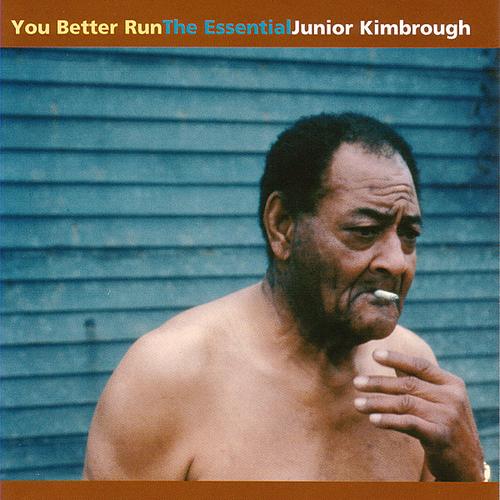
Gathering the best of his all-too-brief recording career, You Better Run: The Essential Junior Kimbrough includes most of his best-known songs, including "Done Got Old," "Meet Me in the City," "You Better Run," and "All Night Long." The collection does a good job of representing each of Kimbrough's albums, ranging from the rough-and-ready sound of All Night Long; Sad Days, Lonely Nights' dark, swampy feel (exemplified here by the title track and "Old Black Mattie"); the dense sonics of Most Things Haven't Worked Out's title track; and the gritty, uncompromising edge to God Knows I Tried's "Tramp." For anyone unsure where to dive into Kimbrough's catalog, You Better Run offers the ideal starting point.
Junior Kimbrough - You Better Run : The Essential Junior Kimbrough [2002/FLAC]
Gathering the best of his all-too-brief recording career, You Better Run: The Essential Junior Kimbrough includes most of his best-known songs, including "Done Got Old," "Meet Me in the City," "You Better Run," and "All Night Long." The collection does a good job of representing each of Kimbrough's albums, ranging from the rough-and-ready sound of All Night Long; Sad Days, Lonely Nights' dark, swampy feel (exemplified here by the title track and "Old Black Mattie"); the dense sonics of Most Things Haven't Worked Out's title track; and the gritty, uncompromising edge to God Knows I Tried's "Tramp." For anyone unsure where to dive into Kimbrough's catalog, You Better Run offers the ideal starting point.
Temple of the Dog - Temple of the Dog (1991) [25th anniversary Deluxe Edition 2016/FLAC]
Featuring members of Soundgarden and what would soon become Pearl Jam, Temple of the Dog's
lone eponymous album might never have reached a wide audience if not
for Pearl Jam's breakout success a year later. In turn, by providing the
first glimpse of Chris Cornell's more straightforward, classic
rock-influenced side, Temple of the Dog helped set the stage for
Soundgarden's mainstream breakthrough with Superunknown. Nearly every
founding member of Pearl Jam appears on Temple of the Dog (including the
then-unknown Eddie Vedder), so perhaps it isn't surprising that the
record sounds like a bridge between Mother Love Bone's theatrical
'70s-rock updates and Pearl Jam's hard-rocking seriousness. What is
surprising, though, is that Cornell is the dominant composer, writing
the music on seven of the ten tracks (and lyrics on all). Keeping in
mind that Soundgarden's previous album was the overblown metallic miasma
of Louder Than Love, the accessibly warm, relatively clean sound of
Temple of the Dog is somewhat shocking, and its mellower moments are
minor revelations in terms of Cornell's songwriting abilities. It isn't
just the band, either — he displays more emotional range than ever
before, and his melodies and song structures are (for the most part)
pure, vintage hard rock. In fact, it's almost as though he's trying to
write in the style of Mother Love Bone — which makes sense, since Temple
of the Dog was a tribute to that band's late singer Andrew Wood. Not
every song here is directly connected to Wood; once several specific
elegies were recorded, additional material grew quickly out of the
group's natural chemistry. As a result, there's a very loose,
jam-oriented feel to much of the album, and while it definitely meanders
at times, the result is a more immediate emotional impact. The album's
strength is its mournful, elegiac ballads, but thanks to the band's
spontaneous creative energy and appropriately warm sound, it's permeated
by a definite, life-affirming aura. That may seem like a paradox, but
consider the adage that funerals are more for the living than the dead;
Temple of the Dog shows Wood's associates working through their grief
and finding the strength to move on.
Robert Palmer - Best Of Both Worlds - The Anthology 1974- 2001 [2 CD, 2002/FLAC]
There are usually thought to be two phases to Robert Palmer's
career: an earlier one running from 1974 to 1983, when he explored New
Orleans second-line funk and reggae, backed by members of Little Feat and the Meters
and turned out a series of critically acclaimed, modestly successful
recordings, and a later one, from 1985 on, when he rode his good looks,
some high-fashion videos, and some simplistic hard rock/pop to a series
of big hits on his own and with the Power Station. This two-CD set responds to that view by devoting its first disc to the earlier phase and its second disc to the later one.
Josh White - Complete Recorded Works Vol. 1-6 [1993-1998/FLAC]
To many blues enthusiasts, Josh White was a folk revival artist. It's true that the second half of his music career found him based in New York playing to the coffeehouse and cabaret set and hanging out with Burl Ives, Woody Guthrie, and fellow transplanted blues artists Sonny Terry & Brownie McGhee.
In Chicago during the 1960s, his shirt was unbuttoned to the waist à la Harry Belafonte and his repertoire consisted of folk revival standards such as "Scarlet Ribbons." He was a show business personality -- a star renowned for his sexual magnetism and his dramatic vocal presentations. Many listeners were unaware of White's status as a major figure in the Piedmont blues tradition. The first part of his career saw him as apprentice to some of the greatest blues and religious artists ever, including Willie Walker, Blind Blake, Blind Joe Taggart (with whom he recorded), and allegedly even Blind Lemon Jefferson. On his own, he recorded both blues and religious songs, including a classic version of "Blood Red River." A fine guitar technician with an appealing voice, he became progressively more sophisticated in his presentation. Like many other Carolinians and Virginians who moved north to urban areas, he took up city ways, remaining a fine musician if no longer a down-home artist. Like several other canny blues players, he used his roots music to broaden and enhance his life experience, and his talent was such that he could choose the musical idiom that was most lucrative at the time.
Vol. 1 - 6 September 1929 to 13 November 1933
Vol. 2 - 24 November 1933 to 18 March 1935
Vol. 3 - 18 March 1935 to 7 March 1940
Vol. 4 - 4 June 1940 to 1941
Vol. 5 - 1944
Vol. 6 - 1944-1945
Subscribe to:
Comments (Atom)

